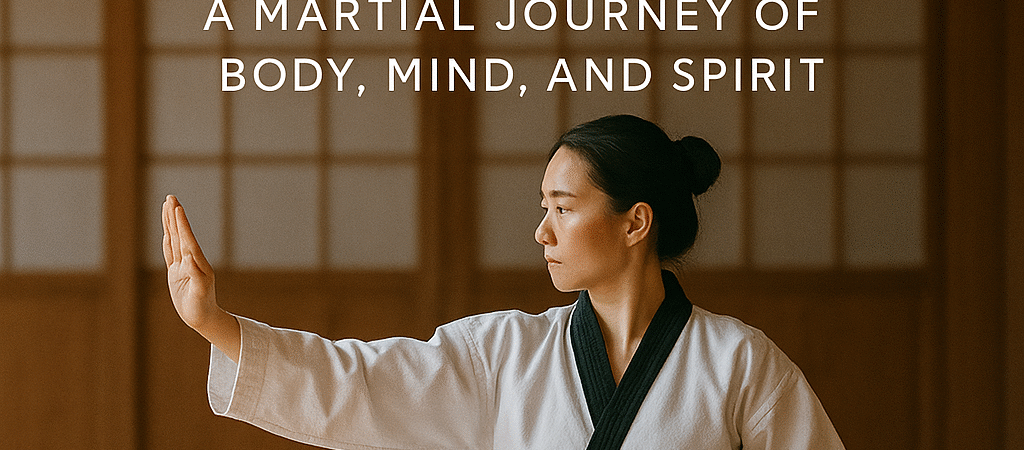
In every stance, strike, and breath, martial arts teaches us the quiet power of balance. It is more than a posture — it is a philosophy, a way of moving through life with strength and purpose.
In Korean martial arts such as Tang Soo Do, Taekwondo, and the older roots of Subak and Taekkyeon, balance (pyeonghyeong, 평형) has always been seen as both a physical discipline and a reflection of inner harmony. To truly master martial arts, one must learn to balance not only the body, but also the heart and the mind.
Physical Balance: The Foundation of Power
In the dojang, the lesson begins with the body. Every technique — whether a powerful front kick (ap chagi), a quick turning block (makki), or a deep front stance (chongul jaseh) — depends on proper balance.
A martial artist with poor balance cannot strike with force or defend with precision. But balance is not just about staying upright — it’s about control. Ancient Korean masters understood that the true source of power comes not from muscle, but from the coordination of movement, breathing, and centered energy.
The term Dan Jun Hoheup (단전호흡) — breathing from the lower abdomen — teaches this connection. When the dan jun (the body’s center of energy, located just below the navel) is stable and filled with breath, the practitioner’s movements flow with grace and power. The body becomes grounded, yet free to move. The center remains steady even as the limbs strike, block, and pivot in motion.
To lose balance in one’s stance is to lose connection with the dan jun — and with it, the unity between body and spirit.
Mental Balance: The Calm in the Storm
Balance of the body cannot exist without balance of the mind. In the Korean martial tradition, this is known as “Jungshin Tongil” (정신통일) — the unification of spirit and mind.
When a martial artist enters a match or steps into a form (hyung), the mind must be still and focused. Thoughts scatter easily — fear, pride, distraction — but mastery begins when the mind becomes steady like a calm lake.
The Hwarang, Korea’s legendary warrior-scholars of the Silla Dynasty, embodied this ideal. They trained their bodies relentlessly, yet placed equal emphasis on philosophy, poetry, and virtue. Their code, Hwarangdo, spoke of loyalty, honor, and self-discipline — the moral balance between strength and compassion.
As one ancient teaching states:
“He who conquers others is strong; he who conquers himself is mighty.”
That same wisdom reminds us that our greatest opponent is not the one before us, but the imbalance within us — impatience, anger, or doubt. To find balance of mind is to find clarity in motion, peace in pressure, and purpose in every strike.
Emotional and Spiritual Balance: The Way of Harmony
In both Korean and Chinese traditions, martial arts are not merely systems of combat — they are ways (Do or Tao) of living.
The Korean word “Do” (도) means “the way” or “the path.” It reflects the lifelong pursuit of harmony between all things — yin and yang, motion and stillness, strength and softness, victory and humility.
In Hapkido (합기도), this philosophy is embodied in the very name: “The Way of Coordinated Energy.” The art teaches that resistance leads to conflict, but flow leads to mastery. The practitioner learns to redirect energy rather than oppose it — to yield when necessary, to strike when right, and to always return to center.
Similarly, in the philosophical teachings of Confucianism and Taoism — both of which influenced Korean martial culture — balance is seen as the highest virtue. The Confucian ideal of Chung Yong (중용), often translated as “The Middle Way,” reminds us not to live in extremes, but to seek harmony in thought and action.
The balanced spirit is not easily disturbed. It acts with kindness when met with anger, steadiness when faced with chaos, and humility when offered praise. This is the spirit of a true martial artist — strong, yet gentle; confident, yet humble.
Balance Beyond the Dojang
The lessons of balance do not end when the training session does.
In daily life, we are constantly pulled in different directions — work and rest, duty and leisure, family and self. Like a martial artist shifting between stances, we must learn to adjust and adapt without losing our center.
Too much focus on success can lead to burnout; too much comfort can dull ambition. The same principles that keep a martial artist stable on the mat can keep us grounded in the world.
- In work, balance reminds us to stay disciplined yet flexible.
- In school, it helps us focus without letting stress overwhelm.
- In relationships, it guides us to listen as much as we speak.
- In training, it teaches us to strive without ego, to rest without guilt.
Every challenge is like a strike coming our way — we can resist it, or we can redirect it with grace and intention.
The Lifelong Practice of Balance
Mastery in martial arts is not about achieving perfection. It is about finding balance between imperfection and effort — between who we are and who we strive to become.
Balance is not something we find once and keep forever. It is something we create every day through awareness, discipline, and humility. Like a spinning top that stays upright only while moving, our balance must be maintained through continual motion and mindfulness.
So as you bow into class, step into your stance, and breathe into your center — remember that each moment on the mat is practice for life itself.
When the body, mind, and spirit move as one, we discover what the masters of old already knew:
“To stand balanced in body is strength. To live balanced in spirit is wisdom.”
Closing Reflection:
Balance is the bridge between chaos and peace, effort and ease, earth and sky.
It is the quiet heartbeat of every martial artist — and the foundation of the Way.

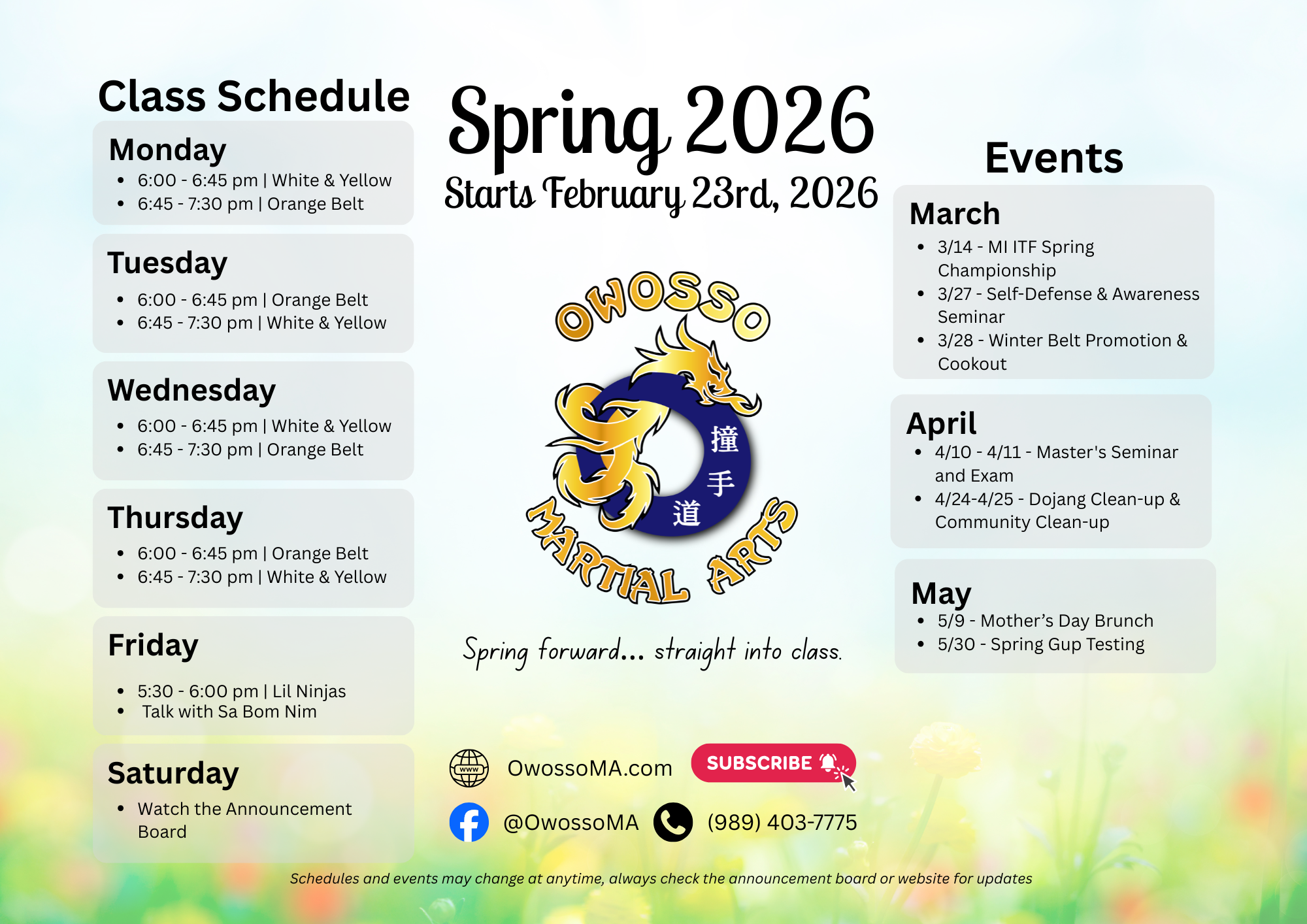
Week of 10/20
Tuesday & Wednesday- Ill Soo Sik
Thursday & Friday- Ho Sin Sul
New Schedule Starts 11/3