Choosing the right martial art can be a tough decision—especially when comparing two respected styles like Shotokan Karate and Tang Soo Do. Both are traditional martial arts with deep roots, powerful techniques, and a commitment to personal growth. But which one is better for you?
In this guide, we’ll break down Shotokan vs. Tang Soo Do across essential areas like history, techniques, stances, sparring, philosophy, and more to help you decide.
—
🔷 1. Origins and History
Shotokan Karate
Founded by Gichin Funakoshi in Japan in the early 20th century.
Developed from Okinawan martial arts like Shuri-te.
Emphasizes discipline, structure, and effective striking.
Tang Soo Do
Developed in Korea by Supreme Grand Master Hwang Kee in the 1940s.
A hybrid of traditional Korean martial arts (like Soo Bahk) and Japanese Karate, especially Shotokan.
Also influenced by Chinese martial arts, creating a broader technical base.
✅ Tang Soo Do benefits from being a blended system with a wider variety of influences.
—
🥋 2. Techniques and Fighting Style
Shotokan Karate
Known for linear, powerful strikes and deep stances.
Focuses on generating maximum force with minimal motion.
Prioritizes punches, blocks, and low kicks with precision.
Tang Soo Do
Features higher, more dynamic kicks, including spinning and jumping techniques.
Uses a mix of linear and circular movements.
Offers a more balanced use of hands and feet, plus open-hand strikes.
✅ Tang Soo Do offers more kicking variety and athletic movement.
—
🧍 3. Stances and Movement
Shotokan
Deep, rooted stances (like zenkutsu-dachi and kiba-dachi).
Emphasizes strong, grounded movement.
Excellent for generating power but less mobile.
Tang Soo Do
Uses slightly higher and more natural stances.
Prioritizes mobility and flexibility over rigidity.
Easier on joints and better for agile movement.
✅ Tang Soo Do offers greater mobility and flow, especially for beginners or older students.
—
🧠 4. Philosophy and Discipline
Shotokan
Strong focus on self-perfection and character development.
Dojo Kun includes values like honesty, respect, and effort.
Emphasizes mental strength and etiquette.
Tang Soo Do
Equally emphasizes respect, perseverance, and humility.
Students follow the ten articles of faith:
1. Be loyal to your country
2. Be obedient to your parents
3. Be loving between husband and wife
4. Be cooperative between brothers
5. Be faithful between friends
6. Be respectful to your elders
7. Be faithful between teach and student
8. Know the difference between good and evil
9. Never retreat in battle
10. Always finish what you start
Tends to incorporate more Eastern philosophy, including meditation.
✅ Both styles share deep philosophical roots, but Tang Soo Do may feel more culturally holistic.
—
🥊 5. Sparring and Competition
Shotokan
Sparring (kumite) often semi-contact or light contact.
Focuses on timing, distance, and form, with clean, controlled techniques.
Kata competition is highly traditional and performance-based.
Tang Soo Do
Uses point-based sparring with light to moderate contact.
Encourages control, strategy, and creative kicking techniques.
Hyung competitions emphasize both form and power, with greater visual variety.
✅ Tang Soo Do sparring is often more dynamic and kick-focused.
—
⚙️ 6. Self-Defense Applications
Shotokan
Practical self-defense techniques, with emphasis on stopping threats with powerful counters.
Direct and efficient but can be limited in close-quarters flexibility.
Tang Soo Do
Includes more joint locks, throws, and evasive movements (thanks to Chinese influence).
Has more options for varying distances and situations.
Adaptable to modern-day self-defense needs.
✅ Tang Soo Do is often more well-rounded for real-world scenarios.
—
🧘 7. Fitness and Accessibility
Shotokan
Builds strong core, balance, and power.
Stances can be tough on knees or hips over time.
Better suited for those who enjoy structure and discipline.
Tang Soo Do
Develops flexibility, speed, and coordination.
High kicks and dynamic motion make it ideal for fitness and agility.
Often more family-friendly and adaptable to all ages.
✅ Tang Soo Do is more flexible for different body types and ages.
🤔 Isn’t Tang Soo Do Just Tae Kwon Do with Punches?
This is one of the most common misconceptions—but the answer is no, Tang Soo Do is not just Tae Kwon Do with punches.
While both styles share Korean origins and even some similarities in forms and terminology, Tang Soo Do and Tae Kwon Do have taken very different paths over the last several decades.
Key Differences:
Tae Kwon Do has become a modern Olympic sport, with a heavy emphasis on tournament-style sparring, rules-based point fighting, and flashy kicks.
Tang Soo Do remains a traditional martial art, focusing on self-defense, character development, and balanced technique—not just competition.
Tang Soo Do’s Traditional Identity:
Forms (hyung) include Chinese circular movements, Japanese kata roots, and Korean kicking techniques.
Training includes self-defense applications, not just sparring drills.
Rank progression emphasizes philosophy, etiquette, and personal growth—not just athletic performance.
Sparring is usually light-contact and point-based, but always practiced with control and respect.
✅ Tang Soo Do is a martial art first, and a sport second—if at all.
It teaches students not only how to kick and punch but how to carry themselves with discipline, humility, and confidence—on and off the mat.
🏁 Conclusion: Which One Is Better? Shotokan or Tang Soo Do
Shotokan is ideal if you’re looking for:
✔️ Deep tradition and structure
✔️ Power-focused striking
✔️ A disciplined, linear fighting style
Tang Soo Do is the better choice if you want:
✔️ A diverse, well-rounded martial art
✔️ Dynamic kicks and flowing techniques
✔️ A style that blends tradition with modern application
✔️ More accessible training for families, kids, and adults of all levels
—
👉 Final Verdict:
While both styles are incredibly valuable, Tang Soo Do offers a more balanced experience—blending tradition, flexibility, and creativity. For those seeking a martial art that supports lifelong practice, physical expression, and personal development, Tang Soo Do may be the superior path.
—
🥋 Ready to try Tang Soo Do?
Experience the difference at Owosso Martial Arts with a free trial class. Discover why more families are choosing Tang Soo Do for confidence, fitness, and fun.

Week of 7/28/2025 – Pre-test Week
- Summer Gup Testing
- When: Thursday, August 7th, 2025 at 5:30pm, arrive early.
- Where: Flushing Karate; 120 N. Cherry Street Flushing, MI
- Make sure you pre-register! Talk to Sa Bom Nim.
- COMING SOON: We will be moving into our new home soon. Tentatively we are planning to start classes August 12th at our new Dojang.
- Location: 1481 E M21 Owosso MI
- Stay Tuned for more updates
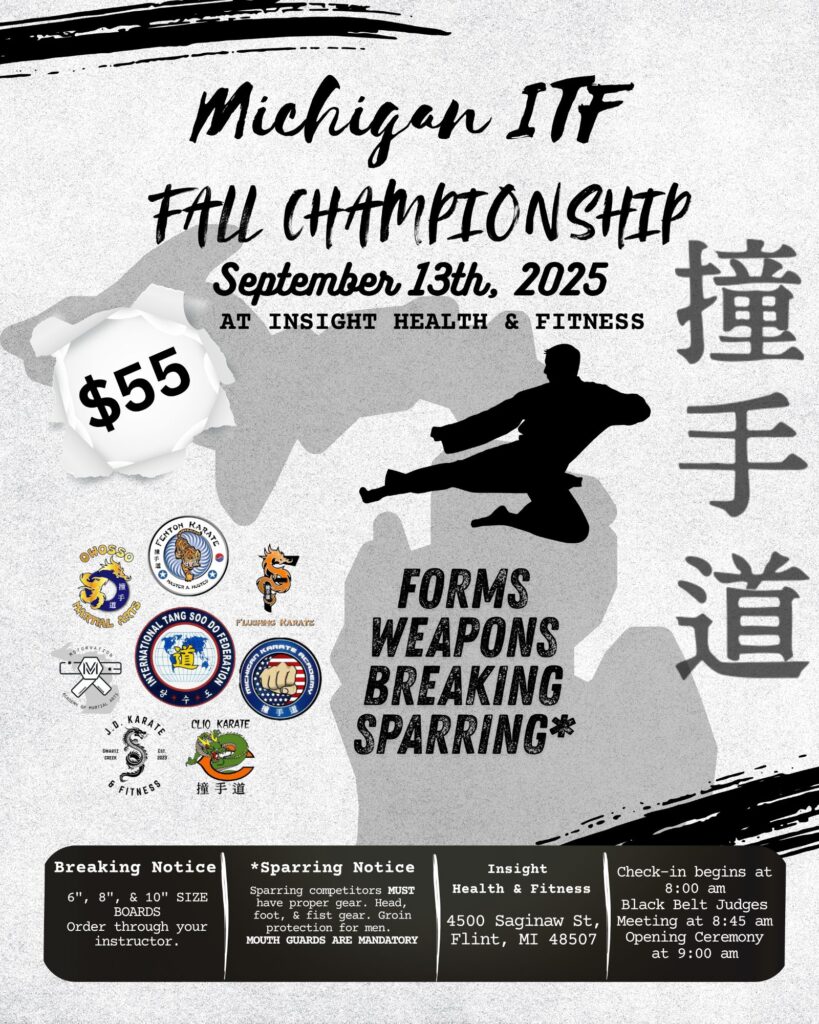
- 2025 Michigan ITF Fall Championship