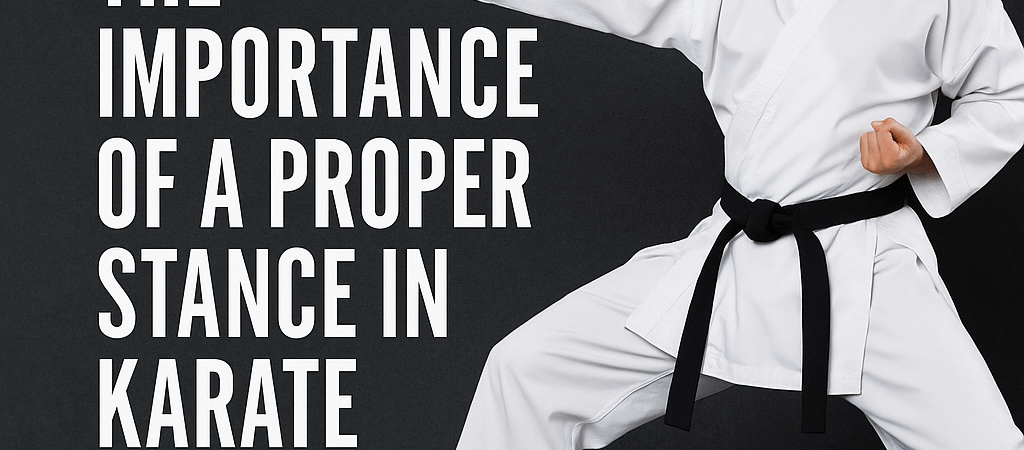
Whether you’re a white belt just starting out or a seasoned martial artist chasing mastery, one of the most essential — yet often overlooked — fundamentals of karate is your stance.
At Owosso Martial Arts, we emphasize proper stance from day one, and here’s why: a strong stance is the foundation for everything in karate — balance, power, movement, and defense. Let’s explore how and why stance matters, backed by science and martial arts expertise.
🧠 The Science Behind a Solid Stance
1. Improved Balance and Stability
Proper stances like Chun Gul Jaseh (front stance) and Keemah Jaseh (horse stance) train your body to stay centered and rooted. According to research published in Gait & Posture (Winter, 1995), postural stability relies heavily on how your center of mass aligns over your base of support. A good stance increases that base, allowing your body to withstand force and deliver techniques with stability.
In simpler terms: good stance = less wobble + more control.
2. Generating Power Efficiently
Ever hear the phrase “power comes from the ground”? It’s absolutely true in martial arts. When you strike, you’re not just using your arm or leg — you’re transferring energy from your legs, hips, and core into the technique. This principle is known as kinetic chain theory.
A 2018 study in the Journal of Human Kinetics found that athletes generate significantly more striking force when using correct lower body mechanics, particularly in stances that allow for hip rotation and weight transfer (Sorensen et al., 2018).
👉 So, the right stance multiplies your power — without needing to “muscle” your way through a strike.
3. Better Defense and Reaction Time
A balanced stance allows you to react quickly — whether you’re blocking, countering, or moving away. Martial arts research from Perceptual and Motor Skills (Delignières et al., 1993) suggests that foot positioning and body alignment directly affect reaction time and speed in combat sports.
This is why karate emphasizes stances that are not too narrow, not too wide, and allow for fluid movement.
4. Injury Prevention
Training in a poor stance can lead to chronic strain on joints, especially the knees and lower back. Physical therapy studies have shown that incorrect weight distribution during athletic movement increases the risk of overuse injuries (Rauh et al., 2006).
Practicing proper stances in karate:
- Teaches muscle memory
- Improves joint alignment
- Reduces risk of falling or twisting improperly during sparring or hyung
🥋 How We Teach Proper Stance at Owosso Martial Arts
At Owosso Martial Arts, our students learn from the ground up. We break down each stance step by step, correcting posture, foot alignment, and weight distribution. Instructors help students understand:
- Why we position the feet a certain way
- How stances link to techniques like punches, kicks, and blocks
- When to use each stance in hyung and ill soo sik
Through repetition, drills, and real-world application, our students build confidence in their footing — and that confidence flows into everything they do, both on and off the mat.
💡 Final Thoughts
A martial artist’s stance is more than just how they stand — it’s how they connect to the ground, balance their body, and prepare to strike or defend. Whether you’re working toward your first belt or your black belt, mastering your stance is mastering your foundation.
Come experience the difference at Owosso Martial Arts, where we help students of all ages stand tall — literally and figuratively.
📚 References:
- Winter, D. A. (1995). Human balance and posture control during standing and walking. Gait & Posture, 3(4), 193–214.
- Sorensen, H., Zacho, M., Simonsen, E. B., Dyhre‐Poulsen, P., & Klausen, K. (2018). Dynamics of the martial arts front kick. Journal of Human Kinetics.
- Delignières, D., Nourrit, D., Caillou, N., Deschamps, T., & Lauriot, B. (1993). Reaction time and posture in martial arts. Perceptual and Motor Skills, 76(1), 129–139.
- Rauh, M. J., Koepsell, T. D., Rivara, F. P., Margherita, A. J., & Rice, S. G. (2006). Quadriceps angle and risk of injury among high school cross-country runners. Journal of Orthopaedic & Sports Physical Therapy, 36(10), 682–690.

Next Weeks Schedule:
We will be doing basic actions on Tuesday & Ho Sin Sul (Self-Defense) on Thursday.
Upcoming Events:
- 18th International Tang Soo Do Federation World Tournament | Washington, DC
- No Class Thursday, July 24th, 2025
- Tournament is July 23rd – July 27th, 2025
- Summer Gup (Under Black Belt) Testing
- Thursday, August 7th, 2025
- At Flushing Karate | 120 N Cherry Street, Flushing MI
- Times to be announced
- Talk to Sa Bom Nim about testing
- Fall ITF Michigan Championship Tournament
- Saturday, September 13th, 2025
- At Insight Health & Fitness | 4500 Saginaw St, Flint MI 48507
- More information to be provided